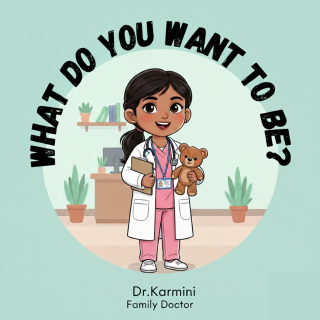
Welcome back to What Do You Want To Be? I'm Mark. And I'm Joy.
Download transcript (.srt)
0:00
0:04
0:09
0:17
0:24
0:33
0:41
0:47
0:54
1:00
1:06
1:14
1:23
1:31
1:37
1:44
1:49
2:03
2:10
2:17
2:26
2:33
2:41
2:48
2:56
3:02
3:09
3:18
3:24
3:31
3:37
3:44
3:51
4:00
4:11
4:16
4:22
4:29
4:34
4:41
4:45
4:49
4:53
5:03
5:10
5:20
5:28
5:34
5:40
5:47
6:00
6:08
6:14
6:23
6:34
6:42
6:48
6:55
7:04
7:11
7:19
7:27
7:36
7:47
7:53
8:05
8:11
8:17
8:23
8:33
8:41
8:50
9:01
9:11
9:22
9:30
9:39
9:45
9:50
9:55
10:01
10:07
10:15
10:21
10:28
10:35
10:42
10:49
10:57
11:03
11:10
11:19
11:25
Our guest today has a very important job. She helps kids and grown-ups stay healthy and feel better
when they're sick. Please welcome Dr. Carmine, a family doctor. Hi Dr. Carmine. Hi Mark. Hi Joy.
Thank you so much for having me in your podcast. I'm really excited to share what I do in day.
What's a typical day like for you? Do you see lots of kids? Yes, I do sweetheart. My day is like
a mix between being a detective, a teacher, a healer and a superhero in a white coat.
Some mornings I'm helping kids with cough or tummy aches. And then I might see a grandma
who needs a blood pressure checked and later a teenager who just wants to know why they're feeling
so tired. And someone might come in because they have injured their arms or their feet. So I need
to do the rest of that. So being a family doctor is truly exciting because I get to look
up to people from babies all the way to great-grandparents. Wow. What are the most
common reasons kids come to see you? Is it usually a cough or a tummy ache? Yes, I see a
lot of coughs, fever and tummy aches and sometimes rashes too. And sometimes it's just a regular
checkup to just make sure they're growing strong and healthy. And honestly speaking,
kids are some of the bravest patients I know even when I have to use a needle at times.
That reminds me of someone.
What's the coolest tool you get to use at your job? Is it the stethoscope? That's hard to say.
So definitely the stethoscope is definitely the star. And you know why? Because I get to listen
to the secret music of your heart and your lungs. So that's pretty exciting. But have you heard of an
autoscope job? No. Autoscope is an instrument that I use to peek into your ears. And that is pretty
exciting too. It feels like I'm exploring a little secret cave. Do you ever have to
solve a mystery when someone is sick and you don't know why? All the time. You know,
being a doctor is truly like being a detective. Sometimes the clues are like cough, tired eyes
or sore tummy. And I have to ask lots and lots of questions. I need to check them carefully.
And then I have to put the puzzle together. And just like in mystery stories, sometimes
the answer is not what you first expect.
What's something that kids think is true about being sick that actually isn't true?
Okay, sometimes kids believe that they always need medicine for running nose or cough.
But actually that's not true at all because your body is already working really hard to fix
itself. So that would be the first thing that I would think that kids probably think it's
you know, not true. And you know what's a funny one? What? Some kids think that when they swallow
a watermelon seed that a watermelon actually grows inside their tongue. I used to think that
if I swallow a seed it will grow inside my stomach. So thankfully that is not true at all.
Yeah. Otherwise everyone would have if a watermelon in trees is growing out of their mouth or their ears.
That would hurt.
What's the hardest part about being a family doctor?
Okay, the hardest part is definitely when someone I care for doesn't get better quickly.
So that makes me pretty sad when we're taking a long time to get better.
And definitely when I have to give a brave child a needle even though I know that they don't like it.
So it hurts me to see them cry and be sad about it.
But I remind myself that it's helping them feel stronger in the long run
and they do definitely need a needle at that point.
Okay, besides washing your hands, what is the most important thing kids can do to stay healthy?
Okay, it's definitely sleep. Do you know that your body is like a form and it needs charging
every single night? So a school going kid probably needs about nine to 12 hours of sleep every night.
So sleep would be number one. Also moving your body, you know, doing activities like running,
dancing and playing is just as important as eating fruits and vegetables.
And of course you cannot forget water. Do you know Joy that 60% of your body is actually
comprised of water? So you need to feel it's it's like fuel for your body's engine, right?
So you need to drink lots of water and stay hydrated.
Okay, now it's time for a segment we're very excited about. Dr. Carmine, we know you're a
detective for real sicknesses but we invented a few silly ones. And we need your expert diagnosis.
We call this Diagnose the Silly Sickness. Joy? Okay, Dr. Carmine, here's my first patient.
Their elbows are giggling, their hair feels like noodles and they can only burp the elbow back.
What do they have? Oh dear, that's a case of tickle noodleitis.
That sounds that sounds serious. Yeah, and you know what's the kill?
What? Three giant spoonfuls of laughter and one dance party to your favorite song.
All right, do we have another one? Okay, this patient's knees are knocking together
but they're not cold. And every time they sneeze, quarter shoots out their nose.
What's the Diagnose? So that's clearly a sparkle sneeze syndrome.
And don't worry, it's not dangerous but it's very very contagious. And the only treatment is to
wear sunglasses indoors and to share the glitter so that everyone shans.
I think now I have a sparkle sneeze syndrome.
All right, that was that was so fun. Thank you.
Before we let you go, we have our two final questions. First, what's your favorite part about being a doctor?
Okay, my favorite part is when someone comes in feeling worried or unwell and they leave smiling
because they feel better. But they've given them some hope and some medication.
So it's like giving them a little piece of their happiness back. So that definitely brings joy to
my life. And last, what advice would you give a kid? Who thinks they might want to be a doctor when
they grow up? You need to stay really curious. You have to ask a lot of questions and not just
about science but about people too. Doctors don't just fix bodies, we listen, we care and we cheer
people on. So if you're someone who likes helping others and solving puzzles, you're already on your way.
Okay, one last tested thing before you go. Sure. What is it done? Okay, I am going to describe
something and you're going to hear a noise. And you have to guess what it is. Okay, sure.
It's something that goes around your arm and when you squeeze it, it's it.
And when you squeeze something, it makes the thing around your arm
and squeeze your arm. Okay.
It's kind of blood pressure machine. Is that what you are?
Okay, thanks.
Okay Joy, do you want to know some fun doctor facts for kids? Sure. Okay.
Do you know that your heart beats about 100,000 times every single day? Oh my gosh.
Yes. That's like the drum that never takes a break. Okay. This is a very important fact.
It's called a sneezing fact. Do you know that a sneeze actually zooms out of your nose
at over 160 kilometers an hour and that's faster than a cheetah can run? Oh my.
Yep. That's how. And the last is a giggle fact.
Laughing is actually very, very healthy for children. It relaxes your body. It boosts your mood
and even it helps your heart. So more giggles, the better.
Okay. That is hilarious.
Okay. Well, thank you, Dr. Carmine for sharing your time and your wisdom with us. This was
so much fun and we appreciate you joining us.
Thank you. Thank you for having me Mark and Joy and always remember to eat your vegetables.
We will and a huge thank you to our listeners. Join us next time for another episode of
What Do You Want To Be?