Welcome back to What Do You Want to Be? I'm Mark, and I'm Joy.
Download transcript (.srt)
0:00
0:03
0:08
0:11
0:14
0:15
0:19
0:23
0:30
0:32
0:37
0:42
0:48
0:52
0:59
1:04
1:10
1:18
1:22
1:30
1:41
1:48
1:57
2:04
2:15
2:23
2:28
2:38
2:44
2:50
2:56
3:04
3:13
3:20
3:23
3:36
3:45
3:54
4:01
4:04
4:10
4:19
4:28
4:36
4:39
4:44
4:49
5:02
5:07
5:15
5:19
5:28
5:36
5:44
5:48
6:01
6:07
6:13
6:19
6:24
6:28
6:30
6:36
6:48
7:01
7:06
7:11
7:15
7:23
7:44
7:52
8:02
8:11
8:26
8:37
8:44
8:50
8:59
9:07
9:14
9:19
9:24
9:31
9:36
9:41
9:48
9:51
9:56
10:03
10:10
10:15
10:26
10:31
10:39
10:51
10:57
11:06
11:17
11:24
11:38
11:43
11:53
12:15
12:21
12:24
12:33
12:41
12:48
12:57
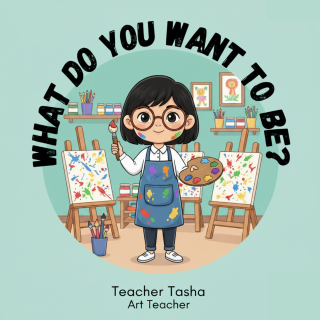
And today we're talking to someone with one of the most colorful and creative jobs.
Please welcome Teacher Kaka and Art Teacher.
Hi, Teacher Tasha.
Hi, Joy.
Hi, Mark. It's so great to be joining you today.
Yeah, it's great to be here. We're actually in your art studio where Joy takes classes,
which is really exciting to be here talking to you about what you do all day.
Joy, you have some questions?
Uh-huh. Okay, so first question.
What do you love about being an art teacher?
Well, there are so many things I love about being an art teacher and also the other parts
which I do not like being an art teacher.
So what I love being an art teacher is that I see different perspectives and creative ideas
of my students when they produce their art pieces.
Well, it's as though I'm seeing the world through their eyes.
Is your job just about teaching kids how to draw on paint or is there more to it?
There are so many other aspects to being an art teacher.
For example, we need to plan our lessons and also the variety of art materials that we use.
We also, at times, we do some craft and also we do some coloring competitions,
setting up books and shopping malls or mini art exhibitions.
We also, yearly, we meet up with parents to talk about child's progress and you tell your art pieces,
which you really love to see what you've done over the years, and meetings,
mostly training, new art techniques, and also sourcing out for new art materials.
We go to special new shops and look for new art materials for inspiration.
So that's why the erasers keep you preparing all over the place.
Yes. We try to get the best erasers.
Do you have a favorite type of art to make?
Like, do you prefer clay or painting or do you have something else?
My favorite medium, probably, is, is even called gouache.
Okay, we just watched. It is actually a combination of watercolor and acrylic paint.
It is very opaque, easy to use, and sometimes I think you use it too without knowing that you're using it.
I love to use watercolor as well and watercolor pencil, which you are also currently using.
Yeah, and I have some.
What happens when a student thinks they made a mistake on their art? What do you tell them?
I would say that it's not a mistake. It's just that you came up differently from
what you can do in your mind. So what I would say is I would ask the student to describe you
and then together we will work it out to what you or what the student is trying to do.
So it's not a mistake.
What's the hardest part about being an art teacher?
Honestly, the hardest part of being an art teacher is actually dealing with parents,
not the students, because of expectations. Each parent, because parents have a different
expectation from students. Students have their own expectations, parents have their own expectations.
So you have to find the balance.
I thought you were going to say, hey, I'm doing, hey, students.
You know, that's the least that I think parents are likely to think.
Hmm. If a kid listening wants to be more creative, but doesn't know where to start,
what one easy project they can try out?
I would suggest by starting to explore a medium that they enjoy. For example,
is it painting? You can start with painting by numbers.
If it's drawing, they can start by drawing. So drawing is the end. It can be monsters.
It could be just lines, scribbles. Then you can proceed to drawing what is in front of you.
For example, head, pencil, table, flower, small part of being something small.
Hmm. It doesn't have to be perfect. Just something that you need to know.
Hmm.
Okay. Well, it's time for our interactive segment. And since we have an art teacher here,
we have to do something creative. This is the scribble challenge.
So teacher Tasha Joy is going to close her eyes. She's going to draw a random scribble
on a piece of paper. Then she's going to describe it to you and me. And our challenge
is to turn that scribble into a picture of something. Are you ready?
And it's also my challenge too.
Yeah. Then we'll have Joy do it as well. All right. Joy is going to pick out
a, is this a pastel from the box here? Yes. All right. So pick out an oil pastel and pick a color, Joy.
An oil pastel is basically a crayon, but it blends. Yeah. And now we're supposed to,
since our audience can't see it, we're also supposed to not see it either. So we're not
going to look at it and then you're going to describe it to us. Okay. Okay. So we'll give you
just a couple of seconds to just make a little scribble without us looking. Go ahead. I chose
purple. Okay. All right. Now pick it up. Pick up your paper. Don't let us see it and describe
it to us. It's a, like a swirl, a loop, and it kind of looks like it's
coming from the distance. Okay. A swirl and a loop and it's coming from the distance. Okay.
I am drawing what I think I'm getting from that. Okay. And now we're supposed to turn that into
a picture of something. You can do it too.
Okay. How's your, how is it going? I'm almost done. How about you?
Wow. Maybe I'll start and tell you what I made. You described it as a
swirl and a loop that's kind of coming from the distance. So I looked at it and I thought that
kind of looks like a torso or the body of something that's maybe a giraffe, but then I turned it into
a sort of a feathery dinosaur that has a long giraffe-like neck. So that's what, that's what
I did there. Yeah. It looks like one of those, like, balloons. It does look like a balloon animal.
Yeah. It's like those cute balloons. Yeah. There's long balloons. Yeah.
Yeah, that's true. It does look like one of those, doesn't it? All right.
Joy, why don't you tell us about yours? Why don't you describe what you did?
You're not done?
All right. Why don't you, why don't you pause and tell us, and then if you want to do more
after the recording, that would work. Okay.
I drew a, like, a butterfly flapping around.
Oh, and I see that it sort of looks like that's the path the butterfly took,
like, if you were drawing a cartoon of a butterfly moving, you might show, like,
where it came from and all the line in the air. Oh, very nice. Okay.
Okay, okay. Mine is like a tip on the series, I mean, something like imaginary.
So it's like a combination of the fish and the snake in the way.
So, yeah. So it's just an imagination. I just, I just feel like he doesn't really really feel like a snake.
So it's like a fish, a fish is a snake. Okay.
I think it's so interesting that we all, we started with Joy's and then we all came up
with something completely different. Yeah. Hey, Dad. Yes? Can we post these doodles in our show notes?
For sure. It'd be fun to show the audience our creativity. Now we can do that. Okay.
Before we go, we have the two final questions we ask everyone. First,
what's your favorite part of your job? My favorite part of my job will be
the students' eyes when they light up after the finish their eyes.
Because I'm a little proud of what they're doing. That's my favorite part of my job.
That's the second question? Yeah.
And last, what advice would you give to a kid who might want to be an art teacher?
When they grow up?
Kind of like in the book, the dot.
Did they talk about that in the dot?
They say just make a dot and see where it takes you. That's good advice, too.
Maybe we'll put a link to that in our show notes as well.
Well, Teacher Tasha, thank you so much for inspiring us to be more creative.
This was so much fun. Thank you. I enjoyed it, too. Thank you so much for inviting me.
And a huge thank you to our listeners. Join us next time for another episode of What Do You Want?